Introduction
USDT is the most popular Stablecoin in the market, but when trading on Ethereum Layer-1, users often face high gas fees and slow confirmation speeds.
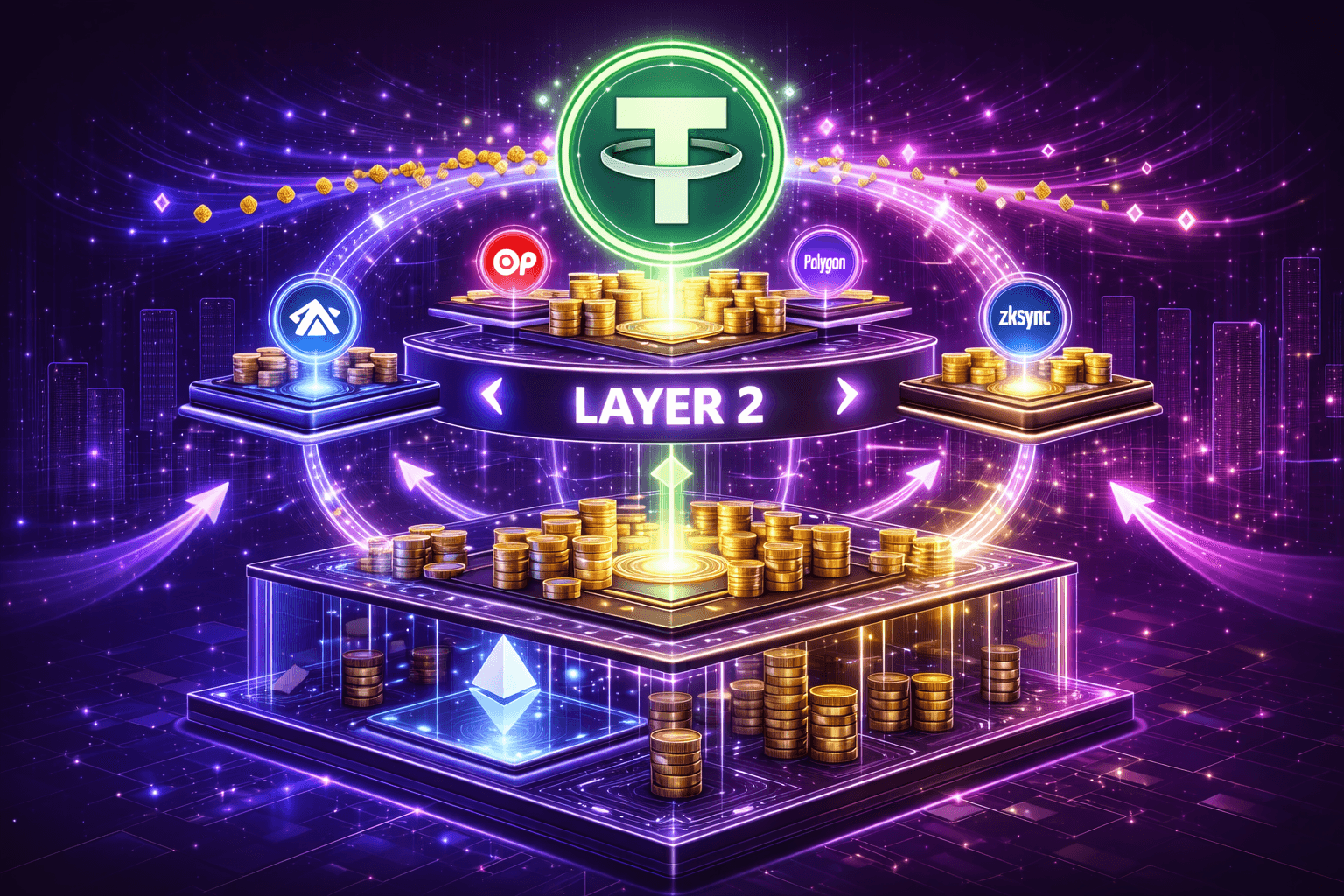
Layer-2 (L2) was created as a solution to optimize transaction costs and performance, making USDT more user-friendly for retail users and DeFi applications.
This article will analyze what Layer-2 is, the platforms supporting USDT, benefits, challenges, and future trends.
1. What is Layer-2?
Layer-2 is a scaling solution on the Layer-1 blockchain (Ethereum, Binance Smart Chain…).
Objective: increase transaction speed, reduce gas fees, and maintain the security of the main network.
Layer-2 does not replace the main blockchain but processes transactions off-chain and then aggregates and records them on Layer-1.
Popular Layer-2 examples: Polygon, Arbitrum, Optimism.
2. USDT on Layer-2
2.1. Reasons USDT shifted to Layer-2
Transaction fees for ERC-20 on Ethereum are high, especially during times of network congestion.
Retail users face difficulties when sending USDT worth a few dozen USD, as gas fees can exceed the transaction value.
Layer-2 helps expand accessibility, especially for DeFi and NFTs.
2.2. Layer-2s supporting USDT
Polygon (MATIC):
Low transaction fees (~$0.01), fast speed.
Supports DeFi, NFTs, staking.
Arbitrum:
L2 Rollup on Ethereum, lower fees than L1, Ethereum security.
Suitable for DeFi transactions with optimal costs.
Optimism:
L2 Rollup, significantly reduces gas fees while maintaining Ethereum's security.
Popular on exchanges and lending platforms.
3. Benefits of USDT on Layer-2
3.1. Cost optimization
Transacting USDT on L2 is much cheaper compared to ERC-20.
Example: An ERC-20 transaction can cost $20, while it only costs $0.01 on Polygon.
3.2. Increased transaction speed
Confirmation is nearly instantaneous, allowing P2P transactions, swaps, and staking to occur more quickly.
3.3. Expanding DeFi for small users
Small retail users can participate in lending, liquidity pools, and swaps without worrying about high gas fees.
Creates opportunities for increasing the number of new users for DeFi.
3.4. Ethereum compatibility
L2 retains Ethereum's security, allowing smart contracts to function normally.
Users do not need to learn a new blockchain, easily transferring USDT from L1 to L2.
4. Challenges of using USDT Layer-2
4.1. Fragmented liquidity
USDT is spread across multiple L2 networks → fragmented liquidity, which can affect swaps and lending.
4.2. Need to bridge between L1 and L2
To transfer USDT from Ethereum to L2, you need to use a bridge, which may incur fees and waiting times.
Risks: Bridge failures or issues with smart contracts.
4.3. Limitations of multi-network DeFi
Some platforms only support ERC-20 and do not accept USDT L2.
Investors need to consider before multi-network trading.
4.4. Dependence on Layer-2
Although Layer-2 optimizes costs, if L2 encounters errors or overloads, transactions may be delayed or fail.
5. Real-world applications
Swap USDT L2: DEXs like QuickSwap (Polygon), Arbitrum One, Optimism DEX allow for fast USDT swaps with low fees.
Lending & Borrowing: Aave, Compound on L2 allow users to borrow and lend USDT with practically negligible gas fees.
Staking & Yield Farming: USDT on L2 enables users to participate in liquidity pools, earning swap fees and token rewards.
NFT & GameFi: USDT L2 is used for buying and selling NFTs, and payments in GameFi with fast speeds and low fees.
6. Tips for using USDT Layer-2
Choose the right L2 for your purpose:
Small transactions, swaps → Polygon, Optimism
Lending, liquidity pools → Arbitrum or Optimism
Use reputable bridges:
Examples: Hop Protocol, Polygon Bridge, Arbitrum Bridge
Check fees and confirmation times.
Monitor liquidity:
Avoid sending USDT to L2 with low liquidity, as it will be difficult to swap or lend.
Diversify across networks:
Use both ERC-20 and L2 to optimize fees, speed, and DeFi interoperability.
7. Comparing USDT L1 and L2
Criteria | Ethereum (ERC-20) | Layer-2 (Polygon/Arbitrum/Optimism) |
Transaction fees | High (~$5-$30) | Low (~$0.01 - $0.50) |
Confirmation speed | 1-5 minutes | Nearly instantaneous |
Decentralization | High | Average (depends on L2) |
DeFi support | High | High (depends on L2) |
Compatibility with Ethereum | Naturally | Needs bridging |
Suitable for | Large DeFi users | Small retail users, P2P, rapid swaps |
8. Conclusion
USDT on Layer-2 is a solution for optimizing costs and speeds for users and DeFi.
Pros: low fees, fast speeds, easy access to DeFi.
Cons: fragmented liquidity, needs bridging, reliance on Layer-2.
Layer-2 makes USDT more user-friendly for small users and increases daily transaction volume, expanding opportunities for DeFi, NFTs, and GameFi, while maintaining the security of Ethereum.