Stablecoins play an important role in the crypto market, helping to avoid price volatility, providing liquidity, and serving as a trading tool between crypto and fiat.
Currently, stablecoins are divided into two main types:
Centralized – Fully controlled by the issuing organization, for example: USDT, BUSD
Decentralized – Operates based on smart contracts, not dependent on a single organization, for example: DAI
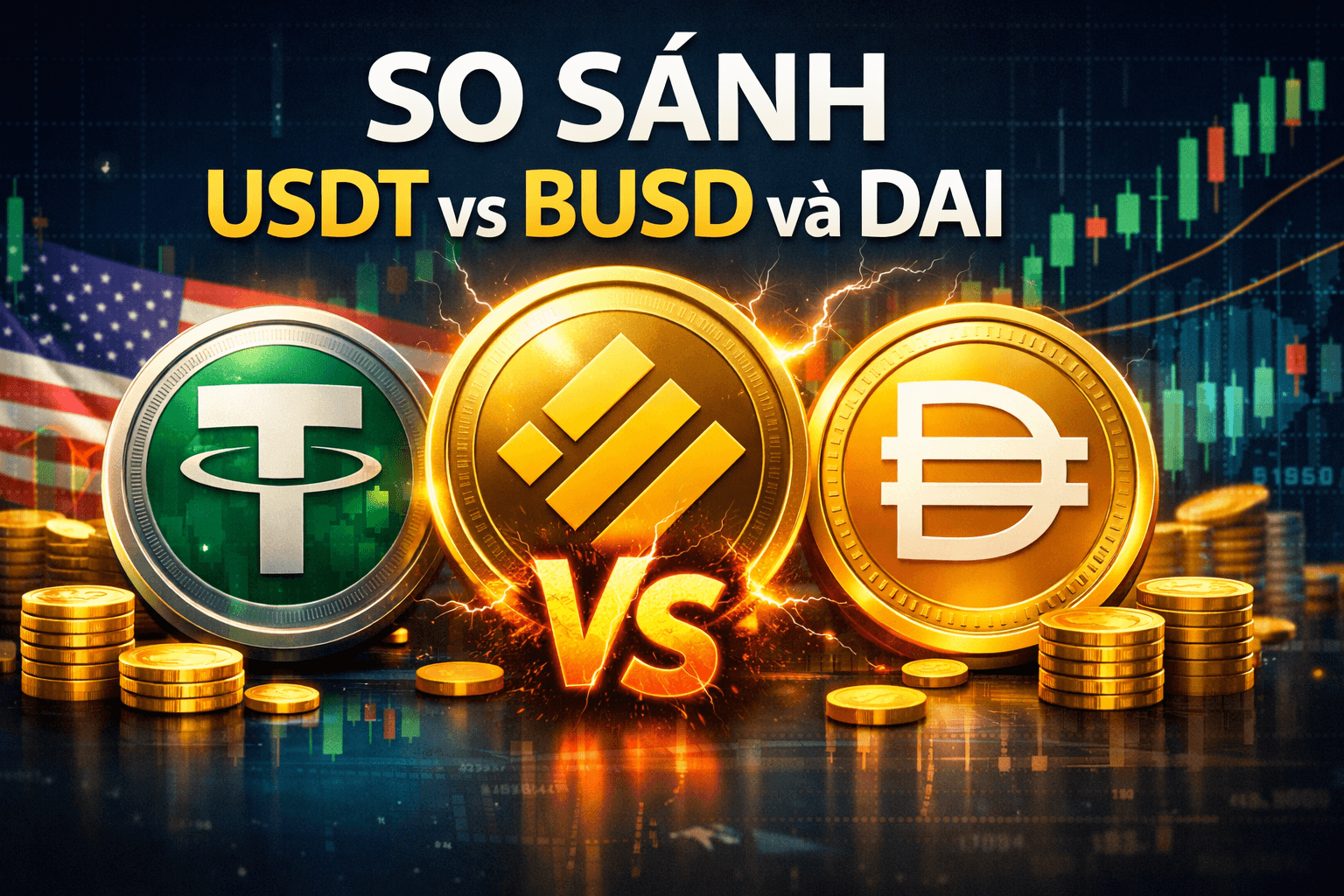
This article analyzes the differences between USDT (centralized) and BUSD (centralized) and DAI (decentralized), from their operational mechanisms, transparency, to real-world applications.
Overview of stablecoins
Stablecoin | Issued by | Type | Popular Blockchain | Reserves |
|---|---|---|---|---|
USDT | Tether Limited | Centralized | Ethereum, TRON… | USD + Commercial Paper + Cash Equivalents |
BUSD | Binance & Paxos | Centralized | Ethereum, BNB Smart Chain | 100% USD |
DAI | MakerDAO | Decentralized | Ethereum | Over-collateralized crypto (ETH, BAT…) |
USDT: the most popular in terms of trading volume and global liquidity.
BUSD: centralized but complies with strict regulations and is audited regularly.
DAI: decentralized, using crypto collateral to peg its price, relying on smart contracts.
Price peg mechanism
USDT and BUSD – Centralized
Mechanism: 1 USDT/BUSD ≈ 1 USD due to the issuer’s direct backing.
Process:
Investor deposits USD → receives USDT/BUSD (Minting)
Investor exchanges USDT/BUSD for USD → the stablecoin is burned (Burning)
Advantages: Stable price, easy to predict.
Disadvantages: Reliant on trust in the issuing organization and regulatory compliance.
DAI – Decentralized
Mechanism: The price of 1 DAI ≈ 1 USD maintained by crypto collateral, over-collateralized.
Tool: MakerDAO’s smart contract monitors the collateral/DAI ratio (usually >150%).
Advantages: Does not rely on a centralized organization, transparency on the blockchain.
Disadvantages: Price can fluctuate if the crypto collateral drops significantly → necessitating a liquidation mechanism.
In summary: USDT/BUSD is more stable, while DAI is decentralized, collateral risk but transparent.
Transparency and legal compliance
USDT
Regular Attestation reports, not fully GAAP audited.
Risks regarding transparency and legality, especially in the US and EU.
BUSD
Regular audits by Paxos, 100% USD reserves.
Complies with US laws and Binance Smart Chain → higher reliability than USDT.
DAI
Operates on MakerDAO, fully on-chain transparent.
Not directly governed by the government, but has smart contract risks or crypto volatility.
Criteria | USDT | BUSD | DAI |
|---|---|---|---|
Transparency | Average | High | High (On-chain) |
Legal compliance | Average | High | Low |
Legal risk | Average | Low | Low |
Real-world applications
USDT
Popular on major exchanges.
Extremely high liquidity → suitable for arbitrage, international trading, DeFi.
BUSD
Suitable for US/EU investors, trading on Binance.
Stable, legally transparent → good for businesses and individuals.
DAI
Suitable for DeFi, lending, yield farming.
Does not rely on centralized exchanges → avoids censorship and legal restrictions.
Investors should choose stablecoins based on purpose: fast trading, legal compliance, or decentralization.
Risks and limitations
Risk | USDT | BUSD | DAI |
|---|---|---|---|
Loss of peg | Possible, low temporarily | Rare | High if collateral decreases sharply |
Legal | Average | Low | Low |
Smart contract | No | No | Yes |
Dependency on organization | High | High | Low |
USDT: legal risk, investor trust.
BUSD: nearly absolutely safe.
DAI: risks from crypto collateral, smart contracts.
Advice for investors
For daily trading, liquidity → USDT
For legal compliance, capital safety → BUSD
For using DeFi, avoiding censorship → DAI
Combining all three to reduce risks, optimize profit, and ensure transparency.
Conclusion
USDT & BUSD: Centralized stablecoins, pegged at 1:1 USD, with high liquidity.
USDT: globally popular, transparency risks.
BUSD: transparent, legally compliant, suitable for the US/EU.
DAI: Decentralized stablecoin, on-chain transparency, reliant on crypto collateral, suitable for DeFi and investors interested in decentralized freedom.
Investors should understand the mechanisms, risks, and applications of each stablecoin to choose or combine their use, optimizing liquidity, capital safety, and legal compliance.